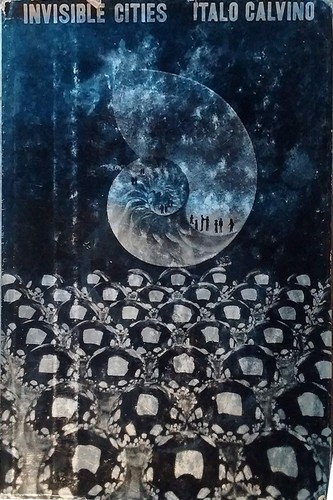
Okay so I picked this up because three separate people over two separate years told me it was their favorite book, which is a strange thing for a book with, functionally, no plot. Marco Polo sits with Kublai Khan and describes cities. That’s it, that’s the engine, same as somebody described it to me before I opened it, and I kept waiting for the frame to snap into a real story the way you wait for a kettle. It doesn’t. The frame is the whole kettle.
Here’s the thing that isn’t in the back-cover copy though, and it’s a detail that shows up scattered through the reviews rather than in the loud consensus everyone repeats about “beautiful prose”: every city in the book is given a woman’s name. Zora, Despina, Zobeide, all the way through, and once you notice that the read changes, because you start hearing it less as an atlas and more as a catalogue of ways of loving or fearing a place, filtered through whatever the narrator projects onto her. I went down a small rabbit hole afterward reading about it as an urban-planning text, of all things, which sounds like a joke until you actually sit with the Zora chapter and realize Calvino is doing something genuinely useful about memory and cities that has nothing to do with fantasy.
The bridge exchange is the one that’s going to stay with me. Kublai Khan asks which stone supports the bridge, and Marco Polo tells him it’s not any one stone, it’s the line of the arch they form together, and then, without missing a beat, “without stones there is no arch.” I read that twice standing in my kitchen. It’s maybe four sentences and it does more philosophical work than most 400 page books manage in their whole runtime.
I won’t pretend it’s an easy read, some nights the middle sections just blur, blur together into one long fog of stone and rooftops, and there were nights I put it down without absorbing a page, but that’s sort of built into the design, a book you’re meant to carry around and reopen at random rather than finish once and shelve. Five stars, not because it’s flawless but because I genuinely don’t know another book like it.