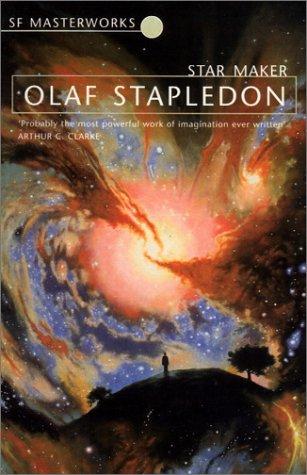
The premise, and I mean this literally, is a guy lying in some grass one night who gets pulled out of his body and goes touring the cosmos, telepathically, across billions of years, watching civilizations rise and collapse and merge into stranger and stranger forms of collective mind. There is no dialogue to speak of. There are no named characters beyond the narrator. Several readers describe it as reading the Wikipedia synopses of eight hundred movies back to back, and honestly, yeah, that’s not wrong, and I loved almost every page of it anyway.
What kept me hooked wasn’t plot, obviously, it’s the sheer rate of invention, Dyson-sphere-adjacent structures, telepathic stars that argue with each other, whole planets engineered into single symbiotic organisms, written in 1937 by a guy who apparently claimed he’d never even heard of the science fiction genre while doing it. I kept stopping to think “wait, this is the book that did that first,” over and over, which is a strange reading experience, less like following a story and more like watching the source code for half of modern science fiction scroll past in real time.
The part that a few readers flag as the weak spot, and I’d agree it’s the most divisive section, is the ending, where the cosmic tour resolves into something close to a creationist account of a Star Maker figure surveying its own failed and successful universes. It’s the one stretch where the book stops feeling like speculative anthropology and starts feeling like theology with a telescope, and depending on your patience for that pivot it either lands as the whole point or as a letdown after everything that came before. I landed on the “whole point” side, mostly because Stapledon earns it by then, having spent three hundred pages building toward the question of what a creator would actually feel looking at its own creation.
Five stars, fully aware this isn’t a book I can hand to just anybody. No characters, no scenes, nothing resembling suspense in the normal sense. But if you’ve ever wanted a book that treats the entire history of everything as its subject and somehow doesn’t collapse under that ambition, I don’t know anything else that does it quite like this.