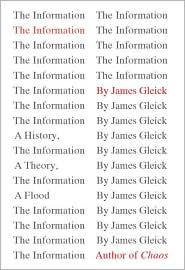
I picked this up expecting something closer to a history of the internet and got instead a history of information itself, starting with African talking drums encoding tonal language across a village, which sounds like a strange opener but turns out to be the most immediately gripping chapter in the whole book. Gleick spends the opening third moving from drums to alphabets to dictionaries and I was fully in, underlining things, telling my partner facts at dinner nobody asked for.
Then Claude Shannon shows up and the book gets harder, harder to hold onto in a different way than the drum chapter was. Not badly written, Gleick is a genuinely good prose stylist, but once the entropy math and the Bell Labs history start stacking up I found myself skimming the equations and reading around them rather than through them, which a decent chunk of other readers apparently also did. What kept me going wasn’t the math itself, it was the connective tissue, the way Shannon’s definition of information as reduction of uncertainty quietly rhymes with the second law of thermodynamics, entropy showing up in two totally different fields wearing the same coat. That’s the kind of observation that made the slower stretches worth pushing through.
There’s a smaller, weirder detail a few reviewers flagged that I can’t stop thinking about: Gleick spends real page count on Ada Lovelace, Babbage’s collaborator, and a handful of readers seemed almost annoyed by it, like it was a detour, when it’s honestly one of the more interesting threads in the whole book, someone doing theoretical computer science before there was a computer to run it on. I wanted more of that chapter, not less.
Three stars, and I feel a little bad giving a book this ambitious a middling rating, but the back half genuinely loses momentum under the weight of its own research, DNA and memes and information glut all crammed in after the Shannon chapters have already done the heavy lifting. Worth reading for the first third alone. Just don’t feel guilty about reading around the math the way I did.