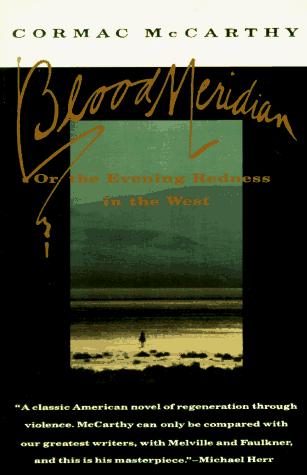
I knew going in that this would be violent, everyone tells you that before you crack it open, but nobody quite prepares you for how McCarthy writes the violence, in the same flat, gorgeous, almost biblical cadence he uses for a sunset. No quotation marks anywhere in the whole book, barely any commas some pages, and the first fifty pages felt like wading through mud while I adjusted to the rhythm of it. Once it clicked though, somewhere around the scalp hunters actually forming up, I stopped noticing the missing punctuation and just felt swept along, which a lot of other readers describe the same way, like getting pulled by a current you didn’t agree to enter.
Judge Holden is the reason this book has stuck with me for weeks after finishing it. He’s enormous, hairless, absurdly well read, and given to these long sermons about war being the truest form of worship, and there’s a real argument he’s the most frightening villain in American fiction precisely because he never behaves like a villain knows he’s one. He’s having a wonderful time. Somebody described the whole reading experience as being handed a gun with exactly one bullet in it as a gift, which is a joke, but it’s also not wrong.
Here’s where I land differently than some reviewers: a chunk of people find the ending infuriating, ambiguous almost to the point of feeling like a non-answer after three hundred pages of escalating horror, “sound and fury signifying nothing,” as one review put it. I actually think that’s the design working as intended. This isn’t a book that’s going to resolve the violence into a lesson you can carry out the door. It just puts you inside it and leaves you there.
Four stars, not five, because the middle stretch of endless raids does blur together if you’re not fully locked in, and I can’t in good conscience call this an easy or even an enjoyable read in the normal sense. But the prose is doing something I haven’t seen anywhere else, and Judge Holden is going to be rattling around in my head for a long time.